Trump says Iran’s government is in a “state of collapse,” but analysts see evolution, not fractures

MGN
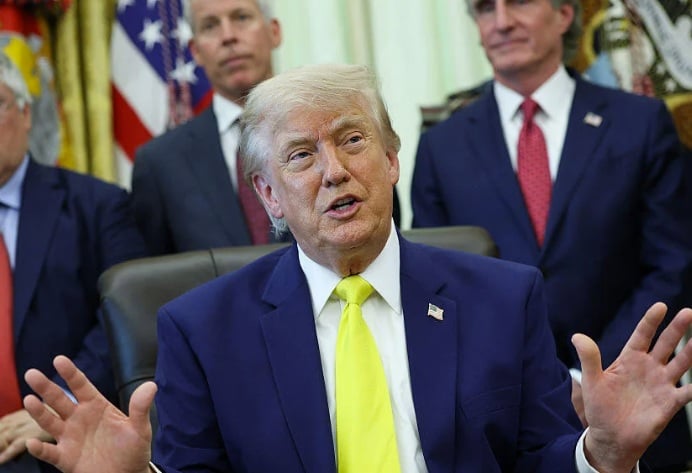
President Trump has said “infighting and confusion” within Iran’s ruling regime is partly why it’s been so difficult to strike a deal to end the war launched by the U.S. and Israel on Feb. 28.
Analysts tell CBS News, however, that while power structures are shifting, there’s little evidence of divisions hampering Iran’s leadership, and Mr. Trump’s rhetoric may be more an effort to find a scapegoat as the White House grapples to present its own policy objectives.
Trump says “nobody knows who is in charge”
A month after former Supreme Leader Ayatollah Ali Khamenei was killed in the first wave of U.S.-Israeli strikes on Iran, sparking a war that has shocked the global economy for more than two months, President Trump announced that regime change in Iran was “complete.”
“The next regime is mostly dead,” he said just days after strikes began on Feb. 28, adding that U.S. negotiators were speaking to “a whole different group” of “very reasonable” people.
He’s changed tack in recent weeks, attributing slow diplomatic progress on a deal to end the war at least partially to Iran’s nearly five decade-old theocratic regime being “seriously fractured” and in a “state of collapse.”
“There is tremendous infighting and confusion within their ‘leadership,” Mr. Trump said in a late April social media post. “Nobody knows who is in charge, including them.”
Ultimate political, military and religious authority has long rested with a single figure in Iran, the supreme leader. Iran named Ayatollah Mojtaba Khamenei as the new holder of that title not long after his father and predecessor, Ali Khamenei, was killed in the first wave of strikes.
U.S. officials say the younger Khamenei was seriously wounded, possibly incapacitated, in the strike that killed his father. There has been no independent confirmation of his condition, and he has not been seen or heard from directly since being announced as the country’s top authority.
At least initially, that invisibility helped fuel perceptions of a power vacuum. But there’s another institution in Iran that has long held significant power, and which may have quickly stepped into any vacuum in Tehran, the Islamic Revolutionary Guard Corps.
An Iranian transition “from divine power … to hard power”
The IRGC is a military, political and economic force that has long answered directly — and only — to the supreme leader. It is responsible for Iran’s external military and paramilitary efforts, including managing ties with a network of so-called proxy forces across the Middle East, and also helping to enforce domestic security, quashing dissent.
A recent article by the Reuters news agency, citing Iranian officials and analysts, suggested the new supreme leader’s role was “largely to legitimize decisions made by his generals rather than issue directives himself,” with power coalescing around a wartime leadership contingent consisting of the Supreme National Security Council, the supreme leader’s office and the IRGC, “which now dominates both military strategy and key political decisions.”
Sanam Vakil, director of the Middle East and North Africa program at London’s Chatham House think tank, agrees that “we are moving into a transition of leadership in Iran,” which she told CBS News could bring “shifts in decision-making more broadly.”
The change has been brewing for a few decades, she said, as the ruling clerics have seen their 47-year grip on power loosen while the IRGC has increased its own, through key business acquisitions and by gaining influence as former members have become politicians.
Aaron David Miller, a Mideast expert and senior fellow at the Carnegie Endowment for International Peace who previously served as a U.S. government negotiator, said on a podcast in April that Iran has “moved from divine power … to hard power” – with the regime now “tethered” to the IRGC.
There have even been rumors that the IRGC could try to stage a coup. But on the ground, that seems unlikely.
The IRGC has always derived some authority from its military strength, but it comes mainly from the unit’s deep and direct connection to the institution of the supreme leader.
Without that link to lend religious and ideological legitimacy, the force could appear to many Iranians simply as another branch of the military, rather than as anointed defenders of the Islamic Republic political order, which a significant portion of the country still supports.
Many Iranian analysts believe that as long as the supreme leader is alive that office will remain the highest authority in the nation.
A regime factionalized “on tactics”
Iran’s President Masound Pezeshkian, whose office is more akin to the vice presidency in the U.S. — decidedly under the supreme leader — is considered a moderate within the regime. Many suspect that he and other political figures favor a return to negotiations, fearful of the consequences of a return to full-scale war with the U.S.
The IRGC, on the other hand, has sought to project no weakness.
“If you attack the infrastructure of the Islamic Republic of Iran, our response will no longer be an eye for an eye, but rather a head for an eye,” IRGC Major General Mohsen Reza’i, a military adviser to Khamenei, said in March.
There have been rumors of a split between IRGC commander Brigadier General Ahmed Vahidi and Mohammed-Bagher Ghalibaf, the parliamentary speaker who led Iran’s negotiating team during the only round of direct talks with U.S. officials since the war began. Those early April talks in Islamabad ended with no agreement to convert the ceasefire into a wider peace deal.
On Monday, Foreign Minister Abbas Araghchi, also part of the Iranian negotiating team, said in a post on X that, “there’s no military solution to a political crisis,” which could be interpreted as a dig at both the U.S., and the IRGC.
Political figures such as Pezeshkian and Araghchi have limited clout in Iran’s power structure, however, and analysts say these differences of opinion – perhaps more public now during the war – pose little threat to the regime.
Vakil told CBS News the regime is, without doubt, factionalized “on tactics, particularly with regard to the negotiations.”
There have been some thinly veiled jabs between the more moderate figures and ultraconservatives, over making concessions to the U.S., for instance.
The IRGC-linked Tasnim news agency published (and then deleted) an editorial in late April mocking ultraconservatives, comparing their expectations for the talks to a “magic beanstalk.”
Ultraconservative cleric and member of Iran’s parliament Mahmoud Navabian, on the other hand, criticized even holding negotiations with the U.S. as “pure damage” for the country, saying on X that, “Iran’s oil is selling for double the pre-war price,” and implying that those who favor a negotiated end to the war are “cowards.”
But the ultraconservatives are a small minority. Iran’s parliament recently voted overwhelmingly in support of a statement backing the negotiating team.
Trump administration “a bit less aligned” than Iran’s regime?
While there are competing viewpoints, Vakil told CBS News the political differences in Tehran look a lot like what she sees in Washington.
Secretary of Defense Pete Hegseth, she says, “is focused on delivering a successful military campaign, whereas [Treasury Secretary] Scott Bessent is focused on the economic portfolio of interests for the U.S.”
“So to me, this is all very normal,” Vakil said, but in Iran, “all of the different groups and individuals are aligned in the preservation of the regime and its security and stability.”
The evolution of power in Tehran does not necessarily indicate fragility in the Iranian regime, but experts tell CBS News the White House may have a vested interest in claiming it does.
“While the Trump administration may have initially hoped for a ‘Venezuela option,’ featuring a Delcy Rodriguez-like figure stepping into leadership, no such option existed” in Iran, Mona Yacoubian, Director of the Middle East Program at the Center for Strategic and International Studies, told CBS News.
“Instead, we have seen that initial decapitation strikes have led to an IRGC-dominated regime in Iran that has adopted a harder-line posture,” she said. “The supreme leader no longer appears to have the final word on decision-making … Instead, decisions regarding Iran’s negotiating posture with the United States appear to be taken by a collective group of IRGC leaders.”
Vakil said she believed Mr. Trump had likely “exaggerated or misrepresented the divisions” in Iran “as an excuse” for a negotiating process that “hasn’t been as easy or quick to deliver on Washington’s side than perhaps Trump has wanted.”
“It’s easy to blame it on [Iran],” she said.
Vakil said she believes Iran’s rulers “have very clear red lines, and it’s much more clear in terms of what they’re trying to achieve, which is the regime’s survival — a permanent deal with guaranteed sanctions relief — whereas the U.S. has been a bit less aligned and less clear.”