Hegseth says U.S. blockade of Iranian vessels to continue for “as long as it takes”

Pete Hegseth | MGN
Washington — Defense Secretary Pete Hegseth said Friday that the U.S. Navy’s blockade of Iranian vessels and ports will remain in place “as long as it takes” and indicated that the Trump administration is in no hurry to reach a peace deal with Iran.
Speaking to reporters at the Pentagon, Hegseth echoed President Trump’s recent comments that the U.S. is in control of the timeline for Operation Epic Fury, which has continued for nearly two months. The president announced Tuesday that a two-week ceasefire with Iran would be extended and the Navy’s blockade would continue until talks with Iranian officials are concluded.
Iran has criticized the naval blockade and argued it is a breach of the ceasefire.
“All they have to do is abandon a nuclear weapon in meaningful and verifiable ways, or instead they can watch the regime’s fragile economic state collapse under the unrelenting pressure of American power, a blockade as long as it takes, whatever President Trump decides,” Hegseth said, adding that with the blockade continuing, “the clock is not on their side.”
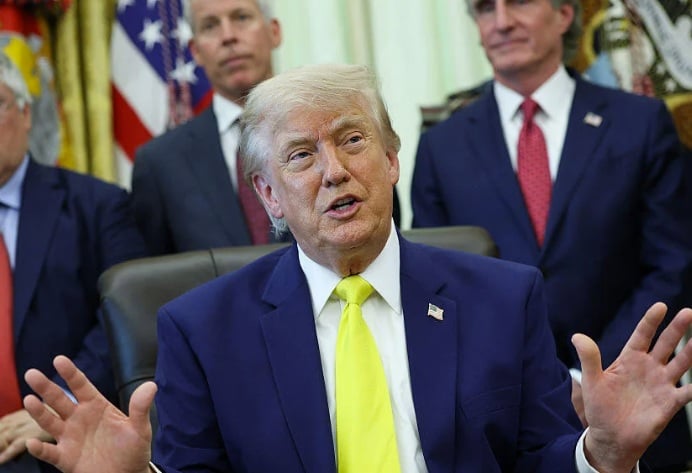
Mr. Trump told reporters at the White House Thursday that the U.S. took out Iran’s military in the first four weeks of the war and “now all we’re doing is sitting back and seeing what deal” would emerge.
Hegseth, too, indicated that the U.S. is not concerned about the duration of the war.
“President Trump said it again yesterday. We have all the time in the world, and we’re not anxious for a deal,” he said.
Still, Hegseth opened his remarks to reporters decrying what he called the “endless wars of the past that dragged on for years and for decades,” and he sought to draw distinctions between the conflicts in Vietnam, Iraq and Afghanistan. Instead, the defense secretary argued that Operation Epic Fury has delivered a “decisive military result” in weeks, with a focus on the mission of keeping Iran from developing a nuclear weapon.
The defense secretary said the mission is continuing into a new phase, and Iran now has the opportunity to make a peace deal.
“Iran has an important choice, a chance to make a deal. A good deal. A wise deal,” he said.
The defense secretary stressed the scope of the U.S. blockade of Iranian ships in the Strait of Hormuz, which he said is “ironclad,” and said a second aircraft carrier will be joining the blockade in the coming days.
“Our blockade is growing and going global,” he said, adding that as of Friday morning, 34 non-Iranian vessels are able to transit the Strait of Hormuz. The defense secretary said many of those vessels are being allowed to move through the Strait, including overnight.
“We are seeing vessels transit, there are paths that are open,” he said, adding that while commercial vessels are moving through the Strait, it’s “much more limited.”
Hegseth also addressed the ships seized by Iran in recent days, saying they were “random ships” that had been targeted and shot at by speedboats.
Following Mr. Trump’s directive Thursday for the U.S. Navy to “shoot and kill” any boat placing mines in the Strait, Hegseth said U.S. commanders have clear rules of engagement.
“If Iran is putting mines in the water, or otherwise threatening American commercial shipping or American forces, we will shoot to destroy. No hesitation,” he said.
Hegseth declined to “speculate on a timeline” for how long it would take the U.S. to clear mines from the Strait, but urged U.S. allies to assist.
Chairman of the Joint Chiefs of Staff Gen. Dan Caine provided details to reporters about the U.S. military blockade, which is being enforced against any ship that is moving to or from an Iranian port or territory. Caine said 34 ships have met the U.S. blockade and turned around, but one, the M/V Touska, was seized.
Two other “stateless” vessels linked to Iran, the M/T Tifani and M/T Majestic X, were interdicted. Their crew remain in U.S. custody, Caine said. Both of the vessels were interdicted in the Indo-Pacific Command’s area of responsibility, which includes the Indian Ocean, according to the Pentagon.
“We will continue to conduct similar maritime interdiction actions and activities in the Pacific and Indian Oceans against Iranian ships and vessels of the dark fleet,” Caine said.
Hegseth was asked about Pope Leo’s recent comments criticizing the war in Iran, which led to insults from Mr. Trump, and the defense secretary defended the U.S. actions.
“We know what our mission is. We know what authority we have,” he said. “We’re very clear about that.”
Hegseth and Cain’s update on the Iran war took place as a weekslong U.S.-Iran ceasefire remains in place while both sides compete for control over shipping traffic in the Strait of Hormuz.
The two have jointly addressed reporters several times since Operation Epic Fury began in late February.
While fighting between the U.S. and Iran is paused, American forces have imposed a blockade on Iranian ports at Mr. Trump’s direction, turning around over 30 ships so far, according to U.S. Central Command. Meanwhile, Iran has sought to control shipping traffic through the strait, claiming Thursday it had collected its first toll revenue at the waterway, a strategically important chokepoint that normally carries one-fifth of the world’s oil.
Tensions have grown in recent days, as the two countries carry out tit-for-tat interdictions of vessels. The U.S. intercepted and boarded a pair of Iran-linked oil tankers, and Iran has attacked and allegedly boarded at least two cargo ships in the strait.
Iran’s Revolutionary Guards released an edited video Thursday that the corps claimed shows masked commandos zipping toward two cargo ships and climbing aboard. The Philippine government said 15 Filipino seafarers aboard vessels that were seized by Iran were “safe and unharmed.”
Mr. Trump said Thursday the U.S. has “total control” over the Strait of Hormuz. He also directed the military to “shoot and kill” any Iranian vessels that try to place mines in the waterway.
Shipping traffic in the strait remains well below pre-war levels.
Earlier this week, the president extended the two-week ceasefire with Iran indefinitely, offering more time for what he described as a severely fractured Iranian leadership to make a deal with his administration. Mr. Trump told reporters Thursday that he will resume bombing Iran if it doesn’t come to the negotiating table, but he’s not in a hurry.
“I want to make the best deal. I could make a deal right now,” he said during an Oval Office event, later adding: “I don’t want to rush myself.”
A ceasefire between Israel and Lebanon was extended by three weeks on Thursday following White House talks between envoys for the two countries. Lebanon could play a key role in any resolution of the Iran conflict due to Israel’s campaign against Iranian proxy group Hezbollah. Iran had pushed for Israel to pause fighting Hezbollah in Lebanon as part of a ceasefire.
This week has also been marked by upheaval at the Pentagon, as Navy Secretary John Phelan left his post at Mr. Trump and Hegseth’s direction. The president told reporters Thursday that Phelan is a “wonderful guy” but had trouble getting along with others.
“He’s a hard charger, and he had some conflicts with some other people,” Mr. Trump said. “Got to get along, especially in the military.”