Oil prices rise toward $100 as stocks slip on doubts about the US-Iran ceasefire
NEW YORK (AP) – Oil prices are climbing back toward $100 per barrel on Thursday, while stock markets worldwide give back some of their big gains from the day before.
The S&P 500 slipped 0.2% as the United States, Iran and Israel disagreed on the details of their two-week ceasefire, whose announcement had sent markets flying in optimism on Wednesday. The Dow Jones Industrial Average was down 166 points, or 0.3%, as of 9:35 a.m. Eastern time, and the Nasdaq composite was 0.2% lower.
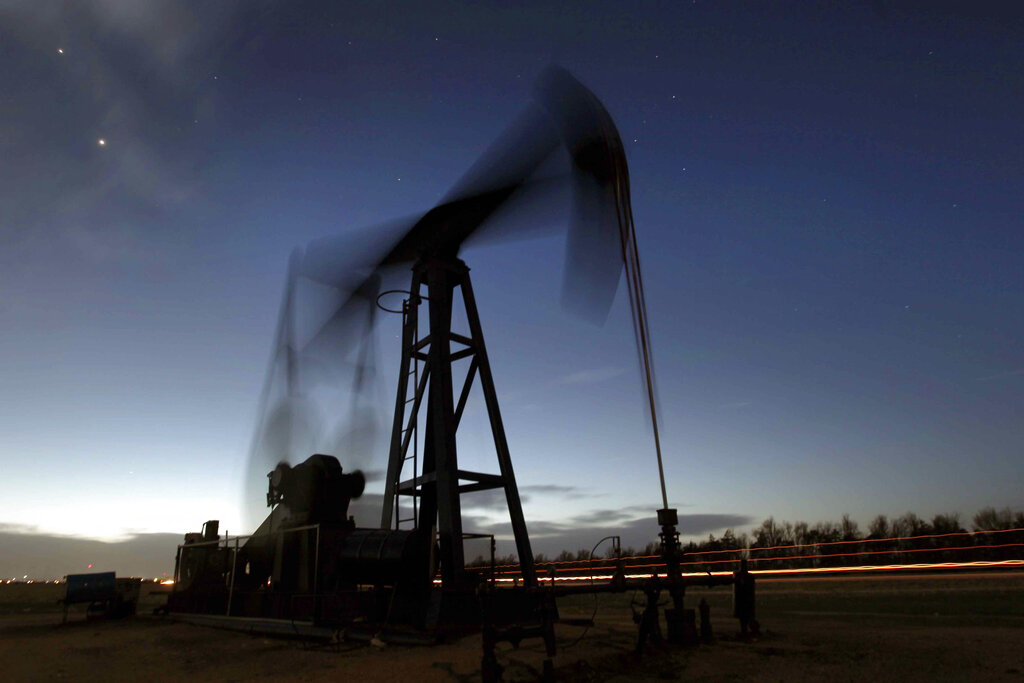
The oil market was shakier, and the price for a barrel of benchmark U.S. crude oil jumped 5.4% to $99.48. It rose after semiofficial news agencies in Iran suggested forces have mined the Strait of Hormuz, the narrow waterway that has been at the center of President Donald Trump’s demands of Iran. Blockages there have kept oil and natural gas stuck in the Persian Gulf, away from customers worldwide.
Brent crude, the international standard, rose 3.5% to $98.06 per barrel. It’s well below the $119 level that it briefly reached when worries about the war reached their height, but it’s still well above its roughly $70 level from before the war.
Given how far apart the United States and Iran seem to be in their demands, upward pressure on oil prices may be “here to stay for a while, even if, as part of a set of concessions, the Strait of Hormuz is reopened to traffic,” according to strategists at Macquarie led by Thierry Wizman.
Even with the ceasefire, risks remain for renewed fighting, which could cause customers worldwide to hoard whatever oil supplies they do get. That could itself keep oil off the market, much like actual fighting targeting pipelines or oil tankers.
A suite of mixed reports on the U.S. economy also helped to keep Wall Street in check. One report said that an underlying measure of inflation that the Federal Reserve considers important was slightly hotter in February than economists expected. It decelerated before the war with Iran began, but not by as much as economists expected.
A separate report said that more U.S. workers applied for unemployment benefits last week than economists expected. The number was not very high compared with history, but it could indicate an acceleration in layoffs.
Treasury yields swiveled up and down in the bond market following the reports but ultimately remained close to where they were the day before.
The yield on the 10-year Treasury remained at 4.29%, where it was late Wednesday. Its leap from 3.97% before the war began has sent rates up for mortgages and other kinds of loans going to U.S. households and businesses.
If oil prices stay high and keep upward pressure on inflation, the Federal Reserve would have difficulty resuming its cuts to interest rates to help the slowing economy, even if the job market keeps weakening. A growing number of Fed officials even seem to be considering the possibility of a hike in rates, according to minutes of their latest meeting released on Wednesday.
In stock markets abroad, South Korea’s Kospi fell 1.6%, and Germany’s DAX lost 1.4% for two of the world’s biggest moves.
___
AP Writers Chan Ho-him, Matt Ott and Aniruddha Ghosal contributed to this report.
(Copyright 2026 The Associated Press. All rights reserved. This material may not be published, broadcast, rewritten or redistributed without permission.)