Olympic hero Jack Hughes has new chiclets as NHL dentists get a moment in the spotlight

Jack Hughes | Associated Press
Jason Schepis was at home with his kids in New Jersey watching the gold medal men’s hockey game at the Olympics when he saw some of his handiwork get scattered all over the ice late in the third period of a thriller.
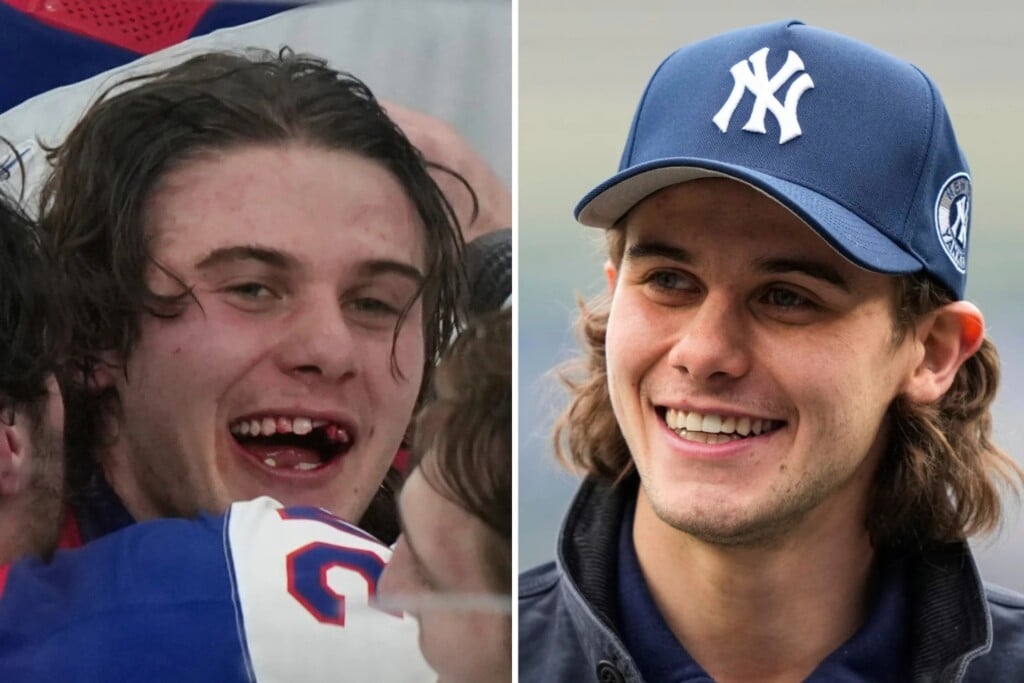
Jack Hughes, the 24-year-old forward for Team USA, had just taken a stick to the mouth from Canada’s Sam Bennett and, as he explained later, saw at least one full tooth and shards of others laying on the ice.
Schepis knew those teeth, too. In fact, as the New Jersey Devils team dentist, he had repaired those very same chompers before after Hughes took a high stick in the playoffs a few years ago.
“We did the root canals, fixed it up,” Schepis recalled. “Those were his teeth.”
Hughes, like hockey players tend to do, shook off the injury, and he went on to score in overtime for a 2-1 win and America’s first gold in men’s hockey since 1980. His gap-toothed grin became the picture-perfect encapsulation of a sport where missing teeth is a badge of honor and “spittin’ chiclets” is so ingrained in the lexicon that it’s the name of a popular hockey podcast, not just the candy-coated chewing gum pieces that are somewhat tooth-sized.
To say that hockey players need dentists is something of an understatement. Every team has one and these specialists join team doctors and other medical staff at every single NHL game, ready to jump into action when the need arises.
“When there is an injury to the mouth, our physicians are like, ‘Oh yeah, we’re so happy you’re here because we would not have been able to do that,’” San Jose Sharks dentist Mark Nishimura said. “Sometimes we’re really not busy, and other times, when it’s bad, it’s bad.”
It was bad when Nishimura was handed Joe Pavelski’s teeth following a puck to the players’ jaw during in the 2019 playoffs, though that resulted in a goal. Later that year, Keith Yandle lost nine teeth, returned to the game and played 168 more in a row.
Brent Burns took a wayward stick to the face in 2013 that knocked out three pearly whites, and since returning he has skated in more than 1,000 games in a row. When a puck ramped off his own stick into his mouth in 2006, Chris Clark needed three hours of surgery involving braces, screws and a cadaver bone .
Hockey dentistry is about triage
Clark calls hockey dentists “triage doctors,” learning about that from his own tooth-losing, palate-fracturing experience with the Washington Capitals.
Longtime Capitals dentist Tom Lenz was there that game and has seen it all, including driving players to his office at night when time is of the essence. Because a puck or a stick to the mouth almost always causes damage different than the general population, he got nervous in his early days more than two decades ago.
“You never know till you get back there, so you always have to be ready to just jump in and take care of it,” Lenz said. “It can be a simple chipped tooth. It can be teeth knocked out. It can be jaw fractures. … We try to get them stable, out of discomfort — whatever that takes.”
That includes dealing with lacerations elsewhere on the faces of players, officials and even coaches. The home dentist, at least in the regular season, is responsible for the visiting team, too, and consults with the other doctors in the building, like when Schepis in early 2024 ruled out Chicago’s Connor Bedard because of a broken jaw.
The playoffs are different, so Schepis was there on the road when Hughes took a stick to the mouth from Jordan Staal in the series opener between the Devils and Carolina Hurricanes in May 2023.
“They’re snapped in half, the nerves are hanging out, the ice is cold (and) he can’t breathe because the nerves are hanging,” Schepis said. “Just numb him right at the end of the first, did the root canals right there, pulled the nerves out. The orthopedic surgeons think it’s like miracle work.”
Smile, you’re a hockey player
When Alex Ovechkin took a stick to the mouth in October 2007 that knocked out one of his front teeth, Lenz put in an implant that’s also known as a “flipper” with the plan to make a permanent fix once his career is over.
Lenz said Ovechkin wanted it immediately, then lost the implant and his smile without the tooth became part of his look, even if his mother did not approve. Ovechkin is now league’s leading career goal-scorer and still playing at age 40.
“Had one made within a day or so because he was so adamant about, ’I can’t go around like this,’” Lenz said. “It’s so him now that it’s going to be strange to see him with all his teeth up there.”
Not Hughes, who told Jimmy Fallon that missing teeth definitely won’t become his look long term. He has already been fixed up.
Now in his 14th full season in the league, Brenden Dillon wore a mouthguard playing as a kid because he needed braces three times from hockey-related incidents. After going without one with the minors, he got popped in the mouth in his first NHL fight and has worn one since.
“Not a fun part of it,” Dillon said. “I don’t think basketball, football — maybe baseball, a ball here and there maybe — but way more in hockey. Sticks, pucks, the glass, ice — the whole nine yards. It feels like once a game at least somebody’s getting dinged up with something.”
Hockey players have a high pain tolerance
Schepis, Lenz and other NHL team dentists work in other sports. Lenz said many of the NBA players he works on have never had sutures before.
“Hockey players sometimes will even go, ‘How many is it going to be?’” Lenz said. “If it’s like two or three or so, a lot of the guys will just go: ‘Then just suture it. No anesthetic, I don’t want to take that. Just suture it and I want to get back out there.’”
Nishimura remembers being asked, “Do you want to put these back in?” when Pavelski lost those teeth off a shot from Burns, his teammate at the time. The Sharks beat Vegas 5-2, and it became part of his courageous career.
“Pavs went back, we numbed him up, sutured him,” Nishimura said. “He went back out and finished the game. It’s incredible. Hockey players, they don’t quit. They are a special breed of human being.”
Dillon, now with New Jersey, has had a couple of root canals, a couple of chipped teeth and realizes he should wear his mouthguard in practices, too. Lenz has noticed a decline in facial injuries since visors were made mandatory; only four players, grandfathered in, are skating without one.
Clark wore a visor sparingly in his playing days but is glad to see the current generation widely adopt it, much like helmets became required equipment, because sticks and pucks to the mouth are such a regular occurrence.
“It’s sort of part of the deal,” Clark said.
So is having a hockey dentist on call. Schepis says he once did a root canal on Jaromir Jagr at 1 a.m. and put in 30-plus sutures for another player when the puck caused damage all the way through his mouth.
“There’s a lot of little nuances to sports dentistry vs. regular dentistry because it’s just not standard,” Schepis said. “You have to move fast and you have to always move with the player’s best intention. But we know they want to be out there. We know the team wants them out there. You always have to be available any time of night.”
(Copyright 2026 The Associated Press. All rights reserved. This material may not be published, broadcast, rewritten or redistributed without permission.)